
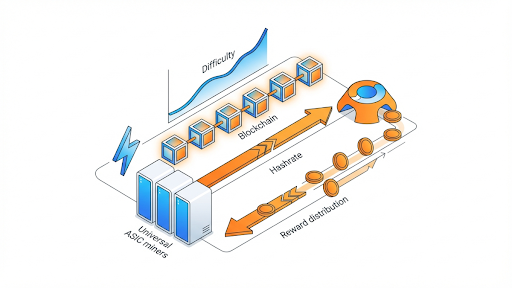
Bitcoin mining represents the computational backbone securing the world’s first decentralized digital currency, transforming electricity and processing power into verifiable proof-of-work that validates transactions and generates new Bitcoin. At its core, mining involves specialized computers racing to solve complex mathematical puzzles, with the winner earning the right to add the next block of transactions to Bitcoin’s permanent ledger and collecting newly minted Bitcoin as a reward. This system eliminates the need for banks or governments to maintain financial records, instead distributing trust across thousands of independent participants who collectively secure over $1 trillion in value. Understanding mining fundamentals—from proof-of-work mechanics to hardware selection and pool participation through platforms offering optimized BTC mining infrastructure – is essential for making informed decisions about profitability and operational strategy.
Table of Contents
Understanding Bitcoin Mining: The Core Concept
Bitcoin mining serves multiple critical functions within the cryptocurrency ecosystem, going far beyond the simple creation of new coins.
What Mining Actually Does
Transaction Verification : Miners collect pending transactions from the network’s mempool and verify their legitimacy, ensuring no double-spending or invalid transfers. Each transaction is checked against Bitcoin’s rules before being included in a candidate block.
Blockchain Security : The computational work required to mine blocks makes it economically infeasible for attackers to rewrite transaction history. To alter past transactions, an attacker would need to re-mine not just one block but all subsequent blocks—a task requiring more computing power than the rest of the network combined.
New Bitcoin Issuance : Mining is the only mechanism through which new Bitcoin enters circulation, following a predetermined schedule that will ultimately cap supply at 21 million coins. This controlled issuance replaces the need for a central bank determining monetary policy.
Decentralized Consensus : Through proof-of-work mining, thousands of independent computers reach agreement on transaction order without requiring a trusted third party. This solves the “Byzantine Generals Problem”—achieving consensus in a distributed system where participants cannot inherently trust each other.
The Mining Process Explained
The mining process follows five distinct steps that repeat approximately every 10 minutes:
- Transaction Collection : Miners monitor unconfirmed transactions waiting in the mempool and prioritize those offering higher fees, creating a competitive marketplace for transaction processing.
- Block Construction : Selected transactions are compiled into a candidate block along with a reference to the previous block’s hash, creating the chain structure that gives blockchain its name.
- Merkle Root Calculation : All transactions are cryptographically hashed together repeatedly until a single hash representing all transactions—the Merkle root—is produced.
- Finding the Nonce : Miners must find a random number (nonce) that, when combined with the block data and hashed, produces a result below a target threshold. This requires billions or trillions of attempts, consuming substantial electrical power.
- Block Broadcast : When a miner discovers a valid nonce, they broadcast the completed block to the network for verification. If valid, the block is added to the blockchain and the miner receives the block reward.
Bitcoin automatically adjusts mining difficulty approximately every two weeks to maintain an average block time of 10 minutes. This self-regulating mechanism ensures Bitcoin’s controlled supply schedule regardless of how many miners participate.
Proof-of-Work: Bitcoin’s Security Foundation
Bitcoin uses proof-of-work (PoW) as its consensus mechanism, fundamentally different from other approaches like proof-of-stake.
Why Proof-of-Work Matters
Trustless System : The entire Bitcoin network operates through mechanized computer consensus rather than relying on trust in any single entity. Every participant must agree to the same data, creating a collective source of truth that no individual can manipulate.
Economic Security : Proof-of-work creates real-world costs for attacking the network. An attacker must expend significant electricity and hardware to attempt fraudulent activities, making honest participation more profitable than cheating. The cost of acquiring 51% of network hashrate far exceeds any potential gain from double-spending attacks.
Fair Distribution : Unlike systems where pre-mined tokens are distributed to insiders, Bitcoin’s proof-of-work ensures coins are earned through measurable computational work. Anyone with electricity and hardware can participate without requiring permission from central authorities.
How PoW Creates Consensus
Blockchains solve the Byzantine Generals Problem by using consensus algorithms to incentivize all participants to agree on a single version of truth. Each node validates transactions independently and reaches agreement on validity. The system records this consensus on the blockchain, creating an immutable, secure, and collectively shared record. The consensus mechanism ensures all participants maintain identical transaction histories and that every transaction follows protocol rules.
Bitcoin Halving: The Supply Control Mechanism
Bitcoin’s supply schedule is governed by a halving mechanism built into the protocol by creator Satoshi Nakamoto.
Understanding Halvings
Halvings occur after every 210,000 blocks of transactions, approximately every four years. The Bitcoin protocol automatically reduces the amount of newly-minted Bitcoin distributed to miners as block rewards by 50%. This creates a predictable supply schedule:
- 2009-2012: 50 BTC per block
- 2012-2016: 25 BTC per block
- 2016-2020: 12.5 BTC per block
- 2020-2024: 6.25 BTC per block
- 2024-2028: 3.125 BTC per block (current)
Impact on Mining Economics
Every halving represents a major challenge for mining operations. Miners have potential profits slashed in half overnight. To compensate, miners constantly seek more efficient machines and cheaper electricity to stay above break-even levels. The halving schedule ensures Bitcoin’s maximum supply will never exceed 21 million coins, with the final satoshi expected to be mined around 2140. As block rewards approach zero, transaction fees are expected to become miners’ primary income source.
Key Profitability Factors
Bitcoin mining profitability depends on multiple interconnected variables that miners must carefully balance.
Bitcoin Price Volatility
The market price of Bitcoin directly impacts mining profitability and represents the most significant variable. Using a Bitmain S19 XP Hydro miner at $0.08/kWh electricity costs as an example: monthly profit could reach $128 if Bitcoin trades at $43,000, but if the price drops to $35,000, profit shrinks to just $40/month. During bullish periods, established miners enjoy higher profits before new competitors enter and increase difficulty, while bear markets force inefficient operations offline.
Electricity Costs
Electricity represents 60-70% of mining operating expenses, making energy costs the primary determinant of long-term viability. The profitability landscape breaks down as follows:
- Below $0.03/kWh : Highly profitable even with older hardware
- $0.03-$0.05/kWh : Competitive with modern equipment
- $0.05-$0.08/kWh : Marginal profitability requiring latest-generation ASICs
- Above $0.08/kWh : Generally unprofitable except during price spikes
Miners increasingly locate operations near renewable energy sources or utilize stranded natural gas that cannot be transported to market. Some participate in demand response programs, earning payments for reducing consumption during grid stress.
Hardware Efficiency
The efficiency of mining equipment—measured in joules per terahash (J/TH)—fundamentally determines profitability. Legacy equipment at 50-100 J/TH is largely obsolete, previous generation hardware at 20-30 J/TH has marginal viability, current generation at 12-18 J/TH is competitive, and latest hardware at 9.5-12 J/TH offers optimal efficiency. Modern ASIC miners provide high computational power with lower energy consumption compared to GPUs or CPUs.
Network Difficulty
Mining difficulty recalibrates approximately every two weeks to ensure steady block creation. When Bitcoin’s price rises, mining becomes more attractive, drawing new participants who increase network hash rate. This triggers difficulty increases, compressing profitability until marginal miners exit. The cycle repeats continuously, creating natural equilibrium.
ASIC vs GPU Mining: Choosing Hardware
The choice between Application-Specific Integrated Circuits (ASICs) and Graphics Processing Units (GPUs) represents a critical decision for prospective miners.
ASIC Mining: Specialized Power
ASIC chips are purpose-built for specific mining algorithms, offering significant advantages in speed and efficiency. A high-end ASIC miner generates terahashes per second (TH/s), whereas even the most powerful GPU typically maxes out at a few hundred megahashes per second (MH/s)—orders of magnitude slower. Modern Bitcoin ASICs achieve approximately 16 J/TH efficiency, compared to 500+ J/TH for GPU mining. This massive efficiency advantage translates directly to profitability.
ASICs are the standard for mining Bitcoin, where high computational power is essential. However, they have significant drawbacks: they’re algorithm-specific and useless if that cryptocurrency becomes unprofitable, have higher upfront costs ($3,000-$15,000+), produce significant noise (70-90 dB) and heat requiring dedicated facilities, and face rapid obsolescence within 2-4 years.
GPU Mining: Flexible Alternative
GPUs are more versatile than ASICs, originally designed for rendering graphics but excellent at parallel processing. A miner can use the same GPU to mine different cryptocurrencies by switching software, providing a safeguard against market volatility. GPUs are widely available through consumer channels and can be repurposed for gaming or other tasks if mining becomes unprofitable.
However, GPUs have critical disadvantages: they consume significantly more power per unit of computational output, deliver reduced hashrates that cannot compete with ASICs on algorithms like SHA-256, generate higher electricity bills due to poor efficiency, and require substantial space—equivalent ASIC power requires 12+ high-end GPUs using 4000+W.
The Verdict
ASICs deliver superior efficiency and profitability in cost-controlled environments mining established coins like Bitcoin. GPUs provide critical flexibility, quieter operation, and better entry points for home miners exploring diverse coins. Serious Bitcoin miners inevitably choose ASICs, while diversified or experimental miners may prefer GPU flexibility.
Mining Pools: Strength in Numbers
Solo mining Bitcoin with individual hardware is essentially impossible for ordinary miners due to the immense computational power required. Mining pools solve this problem by aggregating hashrate from thousands of participants.
How Pools Work
Mining pools combine computational resources from multiple miners, collectively increasing their chances of solving blocks. When the pool successfully mines a block, rewards are distributed among participants proportionally based on contributed hashrate. Different pools employ various payout structures:
- PPS (Pay-Per-Share) : Fixed payment for every share submitted
- FPPS (Full Pay-Per-Share) : PPS plus transaction fees
- PPLNS (Pay-Per-Last-N-Shares) : Rewards distributed only when pool finds blocks
- SOLO : Full block reward to whoever finds it, with pooled resources
Benefits of Pool Participation
Consistent Earnings : Instead of waiting endlessly for the slim chance of mining a block alone, mining pools offer regular payouts. Earnings might be smaller, but they come at a steady pace, making profitability calculations more reliable.
Lower Entry Barrier : Solo mining requires massive computational power and high upfront costs. Mining pools allow even small miners with limited resources to participate and earn proportional rewards.
Reduced Variance : Mining is probabilistic—even with powerful equipment, a solo miner might go months without earning anything. Pool mining smooths out these dry spells by ensuring consistent reward distribution.
Resource Efficiency : By pooling resources, miners collectively increase block-solving efficiency, making the entire process more effective.
Pool Selection Criteria
When choosing a mining pool, consider fee structure (typically 0-4% of rewards), payout method and its variance profile, pool size (larger pools offer more frequent but smaller payouts), reputation and uptime (99.9%+ critical), geographic location for lower latency, and additional features like hashrate derivatives or advanced analytics. While pools contribute to network security through wider distribution, hashrate concentration in the largest pools raises centralization concerns.
Is Bitcoin Mining Still Profitable?
The profitability question has no universal answer—it depends entirely on individual circumstances and constantly changing market conditions.
Who Can Mine Profitably
Large-Scale Operations with direct access to electricity below $0.04/kWh, latest-generation ASIC hardware (12 J/TH or better), economies of scale reducing per-unit costs, and professional facility management remain profitable. Strategic Operators utilizing stranded or curtailed energy, participating in demand response programs, employing vertical integration controlling energy generation, and maintaining flexible hybrid capabilities (Bitcoin/AI computing) can also succeed.
Who Struggles
Small Home Miners face retail electricity rates typically $0.10-$0.25/kWh making most setups unprofitable, inability to achieve economies of scale, noise/heat/space constraints, and lack of access to wholesale equipment pricing. Inefficient Operations using legacy hardware above 20 J/TH, high-cost electricity, poor facility design, and lack of operational expertise leading to downtime also struggle.
Alternative Participation
For those unable to operate profitable direct mining, alternatives include cloud mining contracts (though many have questionable economics), mining company stocks for exposure through public equities, mining pool tokens offering tokenized returns, or direct Bitcoin purchase which may offer better risk-adjusted returns than small-scale mining.
Getting Started with Mining
For those determined to begin despite challenges, a systematic approach is essential.
Step 1: Calculate Profitability
Use mining profitability calculators with realistic inputs: actual electricity costs including all fees, current network difficulty and projected growth, realistic Bitcoin price scenarios, equipment costs including shipping and setup, cooling and facility costs, and pool fees. Be conservative in assumptions.
Step 2: Secure Low-Cost Electricity
This is the single most important factor. Options include negotiating commercial rates with utilities, relocating to regions with cheap power, co-locating with renewable energy facilities, or hosting with established mining data centers.
Step 3: Select Hardware
For Bitcoin mining, modern ASICs are the only viable option. Research current-generation models from Bitmain, MicroBT, and Canaan, evaluating price per terahash, joules per terahash efficiency, warranty and support availability, and delivery lead times.
Step 4: Choose Infrastructure
Decide between home setup (only viable with very cheap electricity and noise tolerance), hosting facility (pay per kWh for professional data center hosting), or self-built facility for serious operations with substantial capital.
Step 5: Join a Pool
Select a reputable pool and configure miners to connect. Monitor performance regularly and be prepared to switch pools if better options emerge.
Step 6: Ongoing Management
Successful mining requires regular monitoring of equipment performance, prompt maintenance to minimize downtime, tracking profitability against Bitcoin price and difficulty changes, strategic decisions about when to sell mined Bitcoin, and hardware upgrade planning as efficiency improves.
Conclusion: The Reality of Modern Bitcoin Mining
Bitcoin mining has evolved from an activity accessible to anyone with a laptop into a highly specialized industry requiring substantial capital, technical expertise, and access to low-cost electricity. The fundamental mechanism—proof-of-work computation securing a decentralized network—remains unchanged, but the scale and sophistication required for profitable participation have increased dramatically.
For most individuals, direct mining is no longer economically viable at retail electricity rates with consumer-grade setups. However, the mining industry continues thriving through professional operations that control costs through vertical integration, energy optimization, and economies of scale. These operations provide the computational security that makes Bitcoin valuable, earning rewards for verifying transactions and maintaining the blockchain’s integrity.
Prospective miners must approach the decision with realistic expectations, carefully calculating profitability based on actual costs rather than optimistic assumptions. For many, alternative participation methods may offer better risk-adjusted returns than operating unprofitable hardware. Yet for those with access to cheap electricity, technical expertise, and sufficient capital, Bitcoin mining remains a viable pathway to accumulating cryptocurrency while contributing to the network’s decentralization and security.