
Post Preview
Table of Contents
Table of Contents
- Automation and AI in Expense Management
- Optical Character Recognition (OCR)
- Hyperautomation and Touchless Expense Reports
- Conversational AI for Enhanced Communication
- Data Privacy and Security
- Integration with Payment Systems
- Real-Time Expense Tracking
- Conclusion
Managing business expenses can be a significant challenge for companies of any size. Traditional systems relied on manual entry, paper receipts, and slow approval cycles, increasing the risk of errors and delaying reimbursements. With the introduction of powerful digital innovations such as expense management platforms, this landscape is seeing rapid advances in automation, accuracy, and ease of use, leading to better business outcomes.
Businesses adopting digital expense tracking leverage features such as artificial intelligence, streamlined receipt scanning, and real-time insights to minimize tedious data entry and reduce human error. These solutions improve employee satisfaction by simplifying the process, allowing staff to focus more time on their primary responsibilities and less time on paperwork. With integrated systems, businesses can now enforce company policies, prevent fraud, and optimize spending, ultimately transforming finance teams into strategic partners instead of administrative bottlenecks.
Today, expense management technology brings efficiency and compliance together, empowering organizations to control costs, maximize visibility, and minimize effort and risk. This shift is driving a deeper adoption of digital-first finance solutions as a best practice for modern companies.
Access to digital tools ensures every step, from capturing receipts to finalizing approvals, is timely and secure. Trends show that businesses switching to cloud-driven expense tracking not only streamline workflows but also boost productivity and accuracy across finance operations.
Automation and AI in Expense Management
Artificial Intelligence (AI) is swiftly transforming expense management by drastically reducing manual errors and time spent on financial processes. Companies using AI platforms report up to a 90% reduction in data entry errors and a 70-90% reduction in processing time. Intelligent automation proactively detects non-compliant spending and potential fraud, supporting more intelligent decision-making and continuous improvement of company policies. AI-driven analytics also deliver actionable insights, enabling finance departments to optimize operational costs and support business growth.
Optical Character Recognition (OCR)
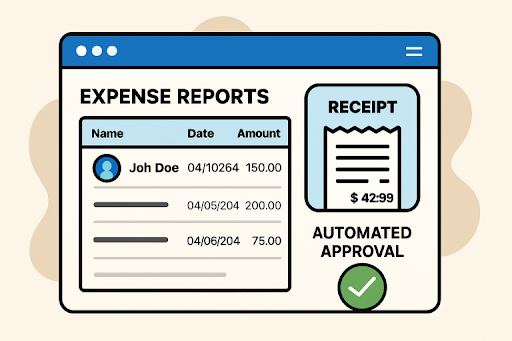
Optical Character Recognition (OCR) technology is revolutionizing the way employees submit expenses. By automatically extracting text and details from submitted receipts or invoices, OCR eliminates the need for manual data entry and lowers the likelihood of mistakes. Staff members take a quick photo of a receipt, and the software populates all relevant information, date, vendor, and amount instantly into the system. This not only accelerates reimbursements but also improves the accuracy and traceability of company-wide spending.
Hyperautomation and Touchless Expense Reports
Hyperautomation combines AI, machine learning, and robotic process automation (RPA) to automate complex, repetitive tasks in expense management that once required human input. These systems can extract data from invoices, match receipts to card transactions, and automatically flag discrepancies or policy violations. Touchless expense reports are now a reality: employees make purchases with corporate cards or integrated payment apps, while the back-end system handles the rest. This enables finance teams to manage higher volumes with less effort, ensure data consistency, and uphold compliance standards.
Conversational AI for Enhanced Communication
Conversational AI and chatbots are now key tools for employee engagement and support in the expense management process. Employees can easily check the status of reimbursements, clarify company expense policies, or receive proactive alerts if more documentation is needed for a claim. This reduces administrative delays and streamlines interactions between staff, managers, and finance departments, ultimately speeding up approval cycles and improving satisfaction for all parties involved.
Data Privacy and Security
Security is paramount when handling sensitive financial data, especially as regulations and threats become more complex. Modern expense management platforms employ robust encryption for stored and transmitted data, implement multi-factor authentication to prevent unauthorized access, and anonymize personal information wherever possible. Regular audits and compliance certifications align these platforms with global standards such as GDPR and SOC 2, providing companies and their employees with peace of mind throughout the expense-tracking lifecycle.
Integration with Payment Systems
Expense management technology is increasingly integrated with corporate cards, digital wallets, and bank accounts, creating a seamless expense lifecycle from purchase to reconciliation. These embedded solutions improve process transparency, eliminate the need for manual reconciliation, and give managers real-time visibility into transactions as they occur. The rise of embedded finance is not only streamlining workflows but also preparing companies to adapt to evolving financial regulations and customer expectations.
Real-Time Expense Tracking
Real-time expense tracking tools use machine learning algorithms to instantly categorize transactions, alert users to unusual activity, and provide up-to-the-minute budget insights. Finance leaders can make informed decisions based on current spending trends instead of waiting for end-of-month reports. This immediate feedback helps organizations quickly adjust policies, limit unnecessary expenditures, and remain agile in dynamic economic conditions.
Conclusion
The shift to digital expense management is reshaping finance departments worldwide. Advanced technologies such as AI, OCR, hyperautomation, and enhanced security are making the process far more efficient, compliant, and employee-friendly. As organizations navigate an increasingly digital economy, the adoption and ongoing refinement of effective expense-tracking platforms will remain a crucial driver of financial health and operational success.